When Should Floor Sanding Happen During a Renovation?
Sanding too early means the floor gets damaged by other trades; too late can delay moving in. How to fit floor sanding into the order of a renovation.
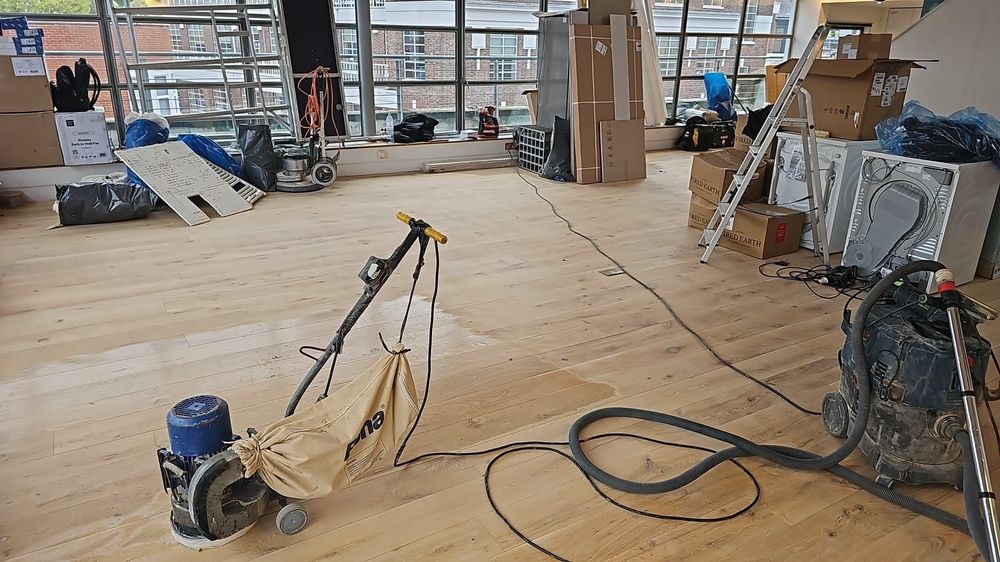
For a shop, office, restaurant or other commercial space, sanding a wooden floor is as much a scheduling exercise as a technical one. The building may need to stay partly open, the landlord may restrict noisy work, and the floor cannot go back into service until the finish allows it. The most reliable projects start by fixing three things early: which areas must stay operational, what the building allows and when, and what "ready to reopen" means for the chosen finish.
Before discussing machines or finishes, list how the space is used:
From that list, decide whether the work can be done in one closure or must be phased zone by zone. Phasing keeps a business running but leaves a visible joint between areas finished at different times, unless the zones are divided at natural breaks such as doorways or thresholds. It also extends the overall programme.
Landlords, managing agents and shared buildings often have their own rules, which can be stricter than any general guidance. Ask about:
If night or weekend work is needed to avoid trading hours, check that it is allowed before planning around it. Out-of-hours noise can still disturb residential neighbours in mixed-use buildings.
Professional sanding with extraction greatly reduces dust, but it does not remove it altogether; our guide to dust-controlled floor sanding explains why. In a business setting that affects:
HSE identifies wood dust as a cause of serious health problems, including asthma, and advises on-tool extraction and suitable respiratory protection for sanding work. Staff and the public should be kept out of active work areas.
High-traffic commercial floors often have more going on than surface wear:
Repairs need to be done before sanding and can add time. A site visit with access to the whole area, plus photographs of any known problems, allows a more realistic programme. Clear the area of anything that cannot be moved by the contractor, or agree who will move it.
A floor that is dry to the touch is not necessarily ready for customers, trolleys or furniture. Finishes have separate times for light foot traffic, full use, placing furniture and covering with mats, and those times change with temperature and humidity. Commercial-grade lacquers are often chosen partly because they reach usable hardness relatively quickly, but the numbers still come from the product's data sheet.
Agree in writing:
Build a little slack into the programme. Cold or humid conditions can extend drying, and a rushed reopening can mark a finish that has not cured.
Not always. Building rules, neighbours, noise limits and the finish's drying conditions all affect whether night work is possible. It should be agreed with the building manager in advance.
Often, if there is safe separation, a route for staff and customers that does not cross the work, and a way to control dust. The joint between phases should be planned.
It depends on the area, repairs, the number of coats and the drying times of the finish. A contractor should give a programme based on a site visit and the actual product to be used.
For initial budgeting, see our published guide prices before agreeing the final scope and programme.
S Wood Floor works on suitable timber floors in offices, shops and other commercial premises across London. See our commercial floor sanding page for how we approach these projects, and contact us with your opening hours, floor area and any building restrictions so the work can be planned around them.