Can Wood Floors Be Recoated Without Sanding?
An intact wooden floor finish may be recoated without full sanding. Preparation, compatibility and adhesion still matter.
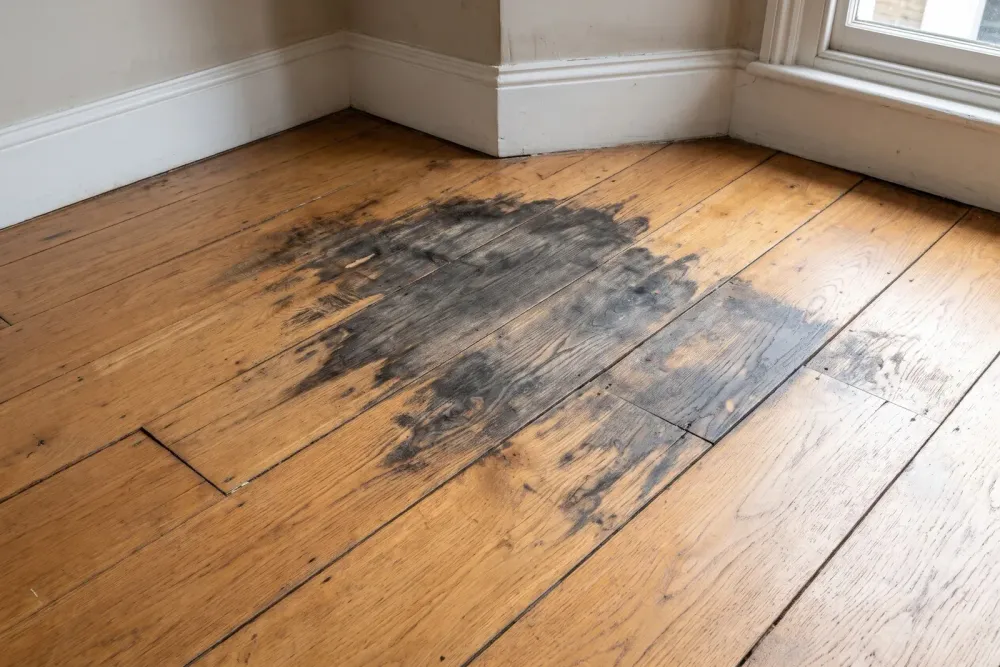
Black marks on wooden floors may come from contamination on the finish or discolouration within the timber. Possible causes include prolonged moisture exposure, iron reacting with natural tannins in woods such as oak, and pet urine. Fungal growth associated with damp conditions can also cause dark marks, but the colour alone does not identify the cause. Some black stains can be reduced or lightened by a professional; others go too deep and the only reliable repair is to replace the affected boards or blocks. No honest contractor can promise complete removal before the stain has been assessed.
Illustrative image (AI-generated): the dark marks shown are not from a documented S Wood Floor project. The cause of staining cannot be confirmed from an image alone.
Timber is not chemically inert. Oak and several other species contain tannins and related extractives, which react with iron in the presence of moisture. The USDA Forest Products Laboratory describes the result as a blue-black or grey discolouration, and lists oak among the woods most prone to it.
This is one explanation for dark marks where water, metal and tannin-rich timber meet: around corroding fixings or beneath a damp metal object. Other staining patterns may have different causes, so visual appearance alone is not proof of an iron reaction.
Water that is left standing, or that seeps under the finish repeatedly, can darken timber. Typical locations include:
Water stains are often larger and less sharply defined than other marks, and may come with swollen, cupped or soft boards.
Where moisture brings iron into contact with oak, a dark stain can form. The iron can come from steel nails or screws, metal furniture feet, a cast-iron object left on the floor, or even fine steel particles from wire wool. The stain often appears as dark rings around fixings or as spots where metal has rested.
The Forest Products Laboratory notes that staining can return if the iron source remains and moisture reaches it again. Identifying and addressing the source is therefore important.
Pet accidents that are not noticed straight away are a frequent cause of dark, often roughly circular stains. Urine can soak through worn or damaged finishes, and the Forest Products Laboratory notes that urine on wood floors speeds up the reaction with iron in wood extractives. These stains may also leave a lingering odour, which is a sign that the timber, not just the finish, is affected.
In damp conditions, mould or other fungal growth can create dark spotting or patches, particularly near external walls, under rugs that trap moisture, or above damp subfloors. This points to a moisture problem that needs to be investigated in its own right.
Where the finish has worn through in busy areas, dirt can work into the exposed grain, leaving a grey or dark traffic lane. This is different from a chemical stain and is often reduced by sanding, provided the floor has enough timber left.
Before deciding on a repair, a few observations help:
Please do not experiment with household bleach, strong acids or other chemicals, and never mix cleaning or bleaching products: some combinations release harmful gases, and aggressive treatments can also leave pale patches that are harder to blend than the original stain.
Any cosmetic repair is wasted if the cause is still there. Depending on what you find, that may mean repairing a leak, improving ventilation, investigating damp beneath the floor, protecting the floor from pets, or removing metal fixings and objects. Where timber has been wet, it should be allowed to dry and stabilise before sanding or refinishing.
The right approach depends on the type of stain, its depth, the timber and how the floor is constructed.
Once the cause has been investigated and the timber is dry and stable, a professional may assess whether careful sanding is appropriate. Sanding removes the finish and some timber; shallow discolouration may reduce, while deeper chemical staining may remain visible. Repeated or aggressive sanding is not a substitute for identifying moisture problems, and is especially risky on floors with a thin wear layer.
Some specialist restorers may consider a targeted wood-bleaching treatment for confirmed iron–tannin stains. The USDA Forest Products Laboratory's technical note discusses oxalic-acid-based treatment, but outcomes vary and the treated area may not match the surrounding timber. This is not a DIY recommendation and does not mean S Wood Floor offers chemical bleaching as part of its standard service. The cause, timber condition and suitability of any specialist treatment must be assessed first.
Where staining is deep, or where the timber is also soft or damaged, cutting out and replacing the affected boards or parquet blocks is often the most predictable repair. Replacement timber needs to match the species, dimensions and grain as closely as possible, and the floor is usually refinished afterwards so that old and new blend. Even with good matching, the repaired area may look slightly different at first. Our wood floor repair service covers board and block replacement.
On some floors, a darker stain colour across the whole floor can make remaining marks much less noticeable. This changes the look of the room and is a design decision as well as a repair. Our floor staining service explains the options.
On older floors, some light marks may be acceptable as part of the floor's history, particularly where removing them would mean replacing original timber. This is a reasonable choice to discuss rather than a failure of the repair.
On engineered flooring, the hardwood top layer is limited, so there is less timber available for sanding out stains. Deep stains in engineered flooring can make board replacement more realistic than repeated sanding, depending on the remaining wear layer and whether matching boards are available. If you are unsure what your floor is made of, our guide to whether a damaged wooden floor can be sanded explains how construction affects the options.
Black stains are one of the harder floor problems to judge from a photograph, because their depth and cause are not always visible. S Wood Floor can assess the condition of stained wooden floors in London and discuss appropriate options such as local repair, sanding where suitable, or board replacement. Any specialist chemical treatment would need separate confirmation. Find out more about our wood floor repairs, or send photographs, the floor type and your postcode with a quotation request.
Sometimes partly. Shallow stains and dirt in worn areas often reduce with sanding, but deep chemical or urine stains frequently remain visible. Sanding usually shows how deep the stain goes.
Iron from steel nails can react with tannins in oak when moisture is present, creating dark rings. If the iron source remains and moisture returns, the marks can reappear.
Not always, but they are often deep. Some can be lightened by professional treatment; many are repaired most reliably by replacing the affected boards.
It is not recommended. Household bleach is not designed for iron-tannin stains, can damage finishes and timber, and must never be mixed with other cleaning products.