To prepare a room for floor sanding, clear everything off the floor that the quotation does not cover, protect what stays in or near the room, and tell the contractor about anything that could affect the work: loose boards, old paint, underfloor heating, pipes and cables, previous leaks. Then plan how the household, including pets, will live around the room while it is sanded and while the finish dries. The aim is not an entirely empty room but one where nothing will surprise anyone on the day.
One to two weeks before: agree the scope
Check your quotation or confirm with the contractor:
- which rooms and areas are included, and whether hallways, landings or stairs are part of the job;
- who moves the furniture, and whether heavy or fitted items are included. Do not assume this is part of the price;
- whether gap filling, repairs or staining are included, or will be assessed on the day;
- the finish to be used and how many coats;
- access: parking, keys, which entrance to use and any building rules on hours if you live in a flat.
This is also the time to book any other trades. Plastering, electrical work and most painting usually go before floor sanding, so if several trades are involved, agree the order with each of them now rather than on the day.
Tell the contractor what you know
Make a short note, with photographs, of:
- loose, squeaky or springy boards;
- wide gaps, missing blocks or old repairs;
- stains, black marks or areas where there has been a leak;
- painted areas, especially in an older property where the paint could contain lead (HSE warns against dry sanding old paint that may contain lead);
- underfloor heating, and where its controls are;
- any pipes, cables or floor boxes you know run close to the surface;
- recently removed carpet, vinyl or tiles, and whether old adhesive or gripper strips remain.
Do not try to fill gaps or fix loose boards yourself beforehand unless you have agreed it. Some gaps indicate movement, and some fillers interfere with later finishing.
Clearing the room
- Furniture. Remove everything that is not agreed to be moved by the contractor. Large items that cannot leave the room should be discussed in advance; sanding around them leaves unfinished areas.
- Rugs, mats and loose items. Take them out completely, including items under beds and in cupboards with a floor that is being sanded.
- Curtains. Lift long curtains off the floor or tie them up; dust settles on fabric.
- Pictures and ornaments. Machine vibration can move items on shelves and walls; take down anything fragile.
- Electronics. Remove or cover computers, televisions and speakers; fine dust can get into vents.
- Wardrobes and cupboards. Empty the bottom of built-in cupboards whose floors are included, and close the doors of those that are not.
- Doors. If doors drag on the floor or need to be removed for access, mention it in advance.
Protecting the rest of the home
Professional sanding with extraction reduces dust considerably, but it does not eliminate it; some fine dust is normal, especially from edging and corner work. Our guide to dust-controlled floor sanding explains what to expect. To limit it:
- close doors to other rooms and, where possible, seal gaps with tape or a draught excluder;
- cover furniture in adjacent rooms and along the route the equipment will take;
- switch off any ducted ventilation or extract fans that could pull dust into other parts of the house, unless the contractor needs them;
- clear the route from the entrance to the room so equipment can come in without damaging walls.
Skirting boards, thresholds and radiators
Skirting boards do not normally need removing for sanding. Edge sanders work up to them, although a fine strip next to the skirting may need hand finishing. If the skirting is being replaced anyway, ask whether it is better to do that before or after sanding.
Door thresholds and bars may need lifting to sand underneath and refitting afterwards; check whether this is included.
Radiators usually stay in place. The floor beneath them can be hard to reach, so ask how it will be treated, and turn radiators off if the finish manufacturer requires lower temperatures during drying.
Pets, children and daily routine
- Plan where pets will stay during sanding and while the finish dries; claws and paw prints mark a soft finish.
- Keep children out of the work area for safety, noise and dust reasons.
- Work out how you will reach bathrooms, bedrooms and the front door without crossing a wet floor.
- Remember the room may be out of use for longer than the sanding itself; the finish needs time before furniture and rugs go back. Our article on how long floor sanding takes explains the stages.
- Have new felt pads ready for furniture legs before everything goes back.
On the day
- Make sure the contractor can access power sockets and, ideally, a sink for cleaning tools.
- Walk the room with them and point out the issues on your list.
- Agree what happens if a hidden defect appears, such as a rotten board under a rug, and how any extra work will be approved.
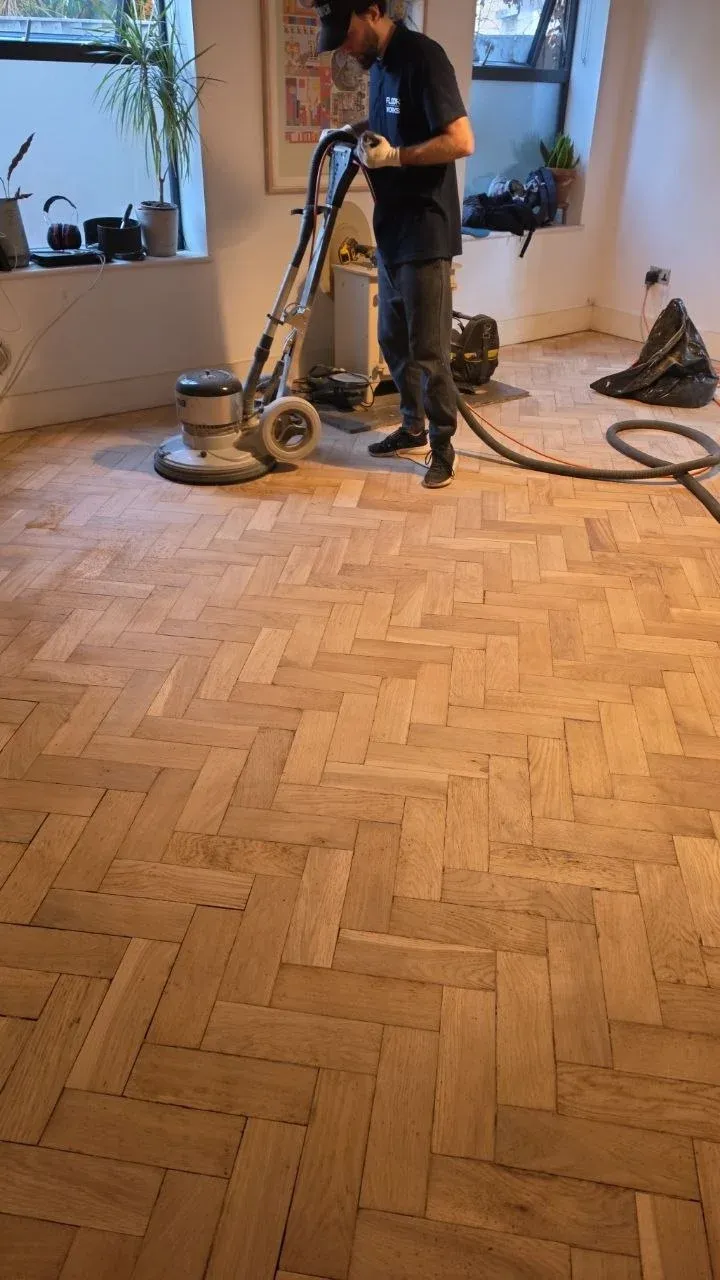
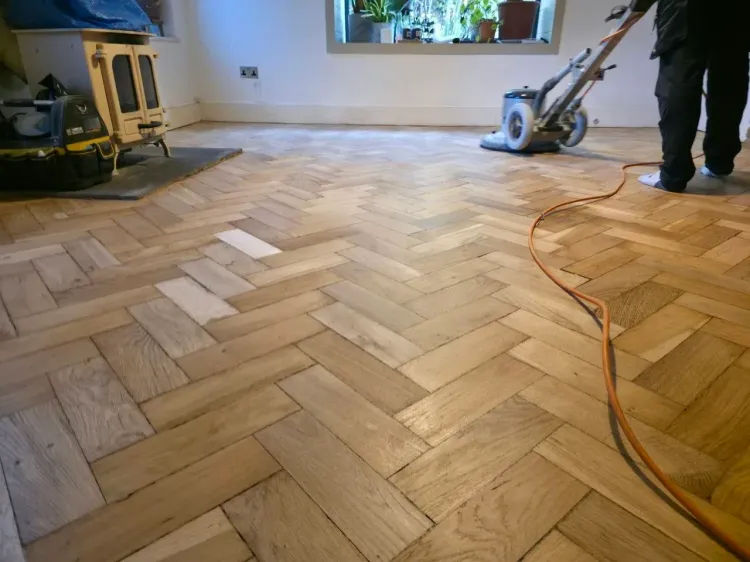
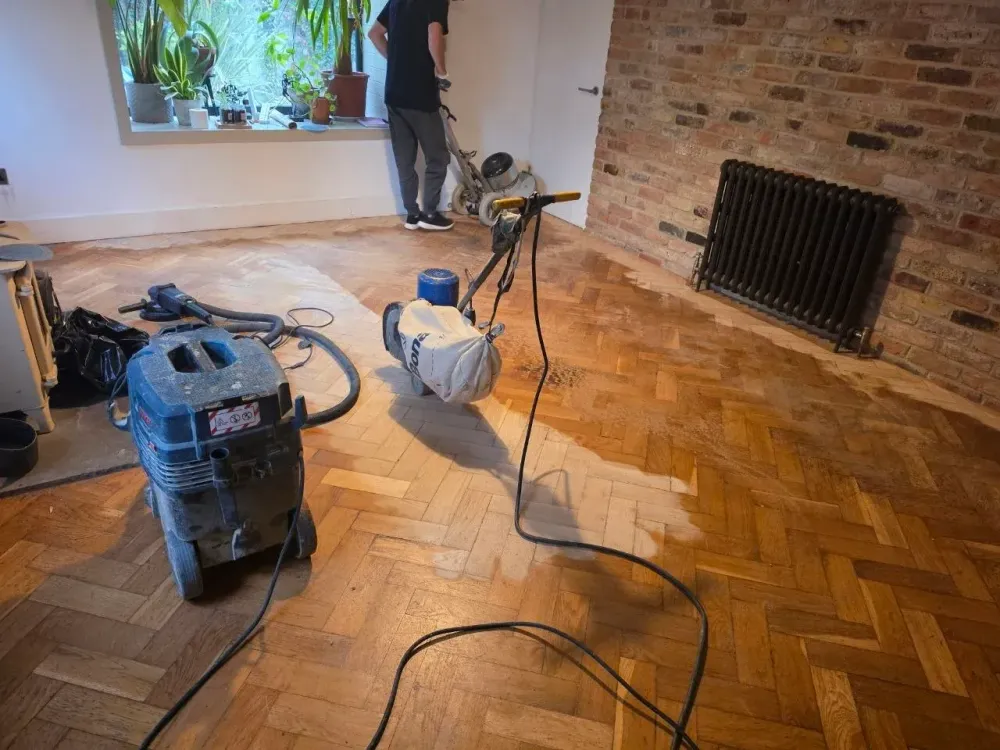
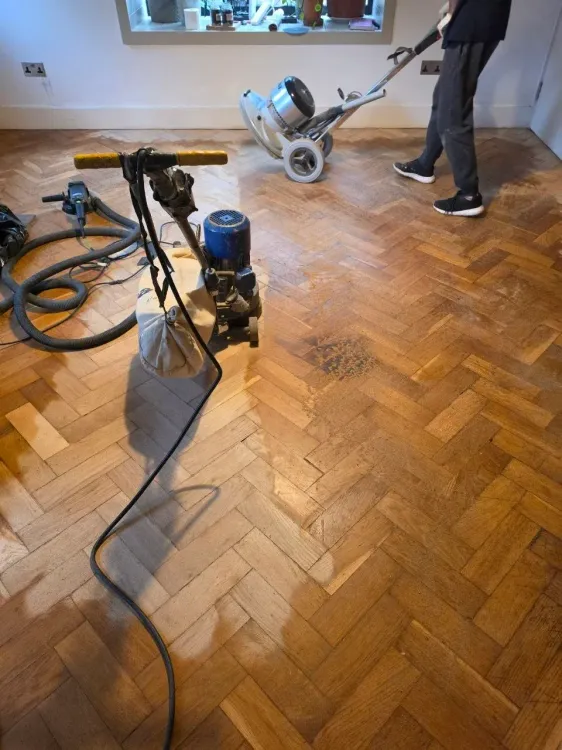
Sanding equipment in use during a herringbone parquet restoration.
Frequently asked questions
Must I take off skirting boards before sanding?
Usually not. Ask the contractor how the edges will be treated. Removal is generally only worth it if the skirting is being replaced.
Should I fill all the gaps myself before the visit?
No. Some gaps reflect seasonal movement and should not be filled, and the choice of filler matters. Agree the treatment with the contractor first.
Can I stay at home during floor sanding?
Usually yes, if you can live in other rooms and reach essential ones without crossing the work area. Sanding is noisy, so working from home in the next room may be difficult.
Book an assessment
You can also read our customer reviews before choosing a contractor.
S Wood Floor discusses furniture, access, repairs and finish requirements before work begins, and confirms what is included in the quotation. Read about our floor sanding service or contact us to discuss your room preparation. Describe the room and any access constraints; we can arrange how to share photographs.