When Should Floor Sanding Happen During a Renovation?
Sanding too early means the floor gets damaged by other trades; too late can delay moving in. How to fit floor sanding into the order of a renovation.
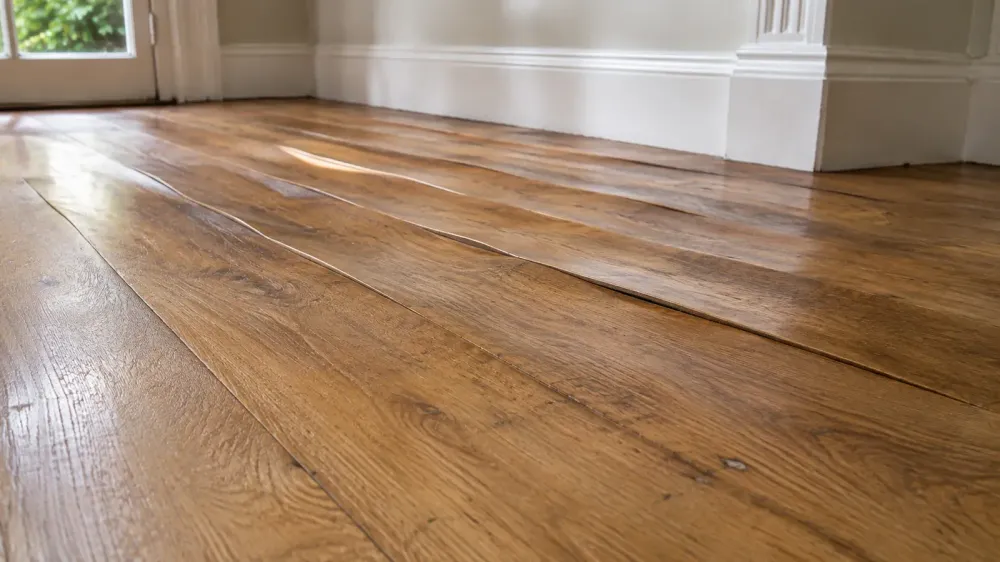
After a leak, a wooden floor should be allowed to dry fully before anyone decides whether to sand, repair or replace it. Wet timber swells, cups and darkens, and much of that can settle as it dries. Sanding a floor that is still wet, or replacing boards that would have recovered, are both expensive mistakes. The first priorities are stopping the water, protecting safety, recording the damage and getting the floor drying. The restoration decision comes later, once the moisture in the boards is close to that of unaffected areas.
Do not sand, seal or refinish at this stage. Do not screw or nail down raised boards to flatten them while they are wet; they are swollen and will shrink again.
The most common signs of water damage on wooden floors are:
Leaks from below, such as a damp subfloor, a failed damp-proof membrane or a hidden pipe, often show as cupping or lifting without obvious surface water.
Drying a wooden floor and its subfloor takes time: days for a small spill on a sealed floor, weeks or longer where water has soaked into a screed, a suspended timber subfloor or the void beneath. The only reliable way to judge progress is to measure.
A moisture meter compares wet and dry areas of the same floor. Readings from the damaged area should come back close to readings from unaffected boards before any restoration starts. A professional may also check the subfloor or screed, which can hold moisture long after the boards feel dry.
As boards dry, cupping often reduces significantly. If boards are sanded flat while still cupped, they can crown once dry, leaving the floor uneven and thinner than before.
Once the floor is dry and stable, the options become clearer:
| Condition after drying | Usual approach |
|---|---|
| Flat or almost flat, finish marked | Clean and recoat, or sand and refinish the affected area or room |
| Slight residual cupping on solid boards | Sanding may level it, if the boards are dry and stable and have enough timber |
| Dark staining in the timber | Sanding to see how deep it goes; local bleaching or board replacement if it remains |
| Delaminated engineered boards | Usually replacement of affected boards; sanding will not reattach layers |
| Loose parquet blocks | Clean and re-bond once the base is dry; replace blocks that are split or distorted |
| Soft, rotten or mouldy timber | Replacement, after the cause has been fixed and the area dried and treated |
Engineered and laminate floors are generally less forgiving than solid wood. Water can get into the core of engineered boards and cause the layers to separate, which sanding cannot fix.
For dark marks specifically, our guide to black stains on wooden floors explains how water and iron-tannin staining are assessed. For loose blocks after a leak, see restoring old parquet: sand or replace.
If water was contaminated, for example from a waste pipe or a flood, or if mould has appeared, the cleaning and any removal of affected materials should be handled by a suitable specialist before floor restoration is considered. Do not dry-sand mouldy timber.
Often, yes. Once it has dried, solid wood that has cupped slightly or been marked can usually be sanded and refinished. Boards that are rotten, badly stained or split may need replacing.
There is no fixed time. It depends on how much water got in, the floor construction and the conditions. Moisture readings close to those of unaffected areas are the signal to proceed.
Not while they are wet. Swollen boards shrink as they dry, and fixing them in a swollen state can lead to gaps, splits and loose fixings later.
Once the leak has been resolved and the floor has had time to dry, contact us to discuss the damage. Tell us the floor type, when the leak happened and any moisture readings available. Our wood floor repair service can assess suitable restoration options; contaminated water or mould requires specialist attention first.
Tell us about your floor and what you would like to achieve. We can discuss suitable options and your requirements.