When Should Floor Sanding Happen During a Renovation?
Sanding too early means the floor gets damaged by other trades; too late can delay moving in. How to fit floor sanding into the order of a renovation.
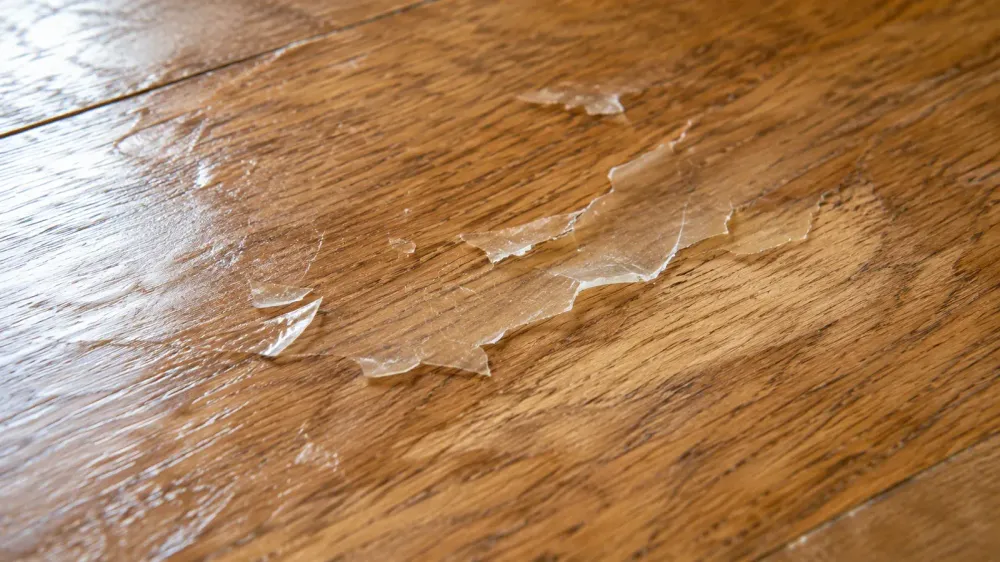
Lacquer peels or flakes when it loses its grip on the layer beneath it. That loss of adhesion usually comes from one of four sources: contamination on the surface before coating, inadequate preparation between coats, products that are not compatible with each other, or moisture and movement in the floor. Because the coating is no longer bonded, adding another coat on top rarely holds. A lasting repair starts with working out where and why the bond failed.
Lacquer is a film finish. It sits on the surface of the wood, or on top of earlier coats, and relies on a mechanical and chemical bond to stay there. When it peels, look closely at the flakes:
Lacquer struggles to bond over wax, silicone-based polishes, oily residues, some cleaning products and even skin oils. A floor that has been regularly "polished" with a shine product can look clean but still carry a film that prevents adhesion. This is one of the most common reasons a recoat fails.
Most lacquer systems need the existing coat to be lightly abraded, cleaned and dust-free before the next one goes on, unless the next coat is applied within the window stated by the manufacturer. Skipping abrasion, or leaving dust and residue on the floor, weakens the bond between layers.
Primers, stains, oils and lacquers are designed to work as a system. A water-based lacquer applied over an incompatible oil or stain, or a recoat with a product that does not suit the existing finish, can fail even when the work is otherwise careful. Manufacturer technical data sheets set out which combinations are approved.
A leak, a damp subfloor or a long-standing spill can lift lacquer from below. Underfloor heating or a radiator can dry boards quickly, opening joints and stressing the film. Boards that move seasonally may crack the coating along their edges.
Temperature, humidity, ventilation and coat thickness all affect how a coating cures. Applying lacquer in a cold or very humid room, or putting too much on at once, can lead to soft, poorly bonded or blistered finish.
Without scraping or testing the floor yourself, note:
That history is often more useful to a contractor than any amount of scraping, because it narrows down the cause.
| Extent | Typical approach | Considerations |
|---|---|---|
| Small, isolated area with a clear local cause | Remove loose finish, prepare and recoat the affected board or section | The edge of the repair may show; sheen must be matched |
| Peeling across an area after a recoat | Remove the failed coat back to a sound layer or bare wood, then rebuild | Contamination must be removed, otherwise the new coat fails too |
| Widespread failure, or failure down to bare wood | Sand back to bare timber and apply a complete compatible system | Timber thickness and condition must allow sanding |
| Peeling caused by moisture or movement | Resolve the moisture or heating issue first, then refinish | Refinishing a damp or unstable floor will repeat the problem |
The key point is that a reliable repair removes all poorly bonded finish. Sealing over loose material, or "touching in" flakes with more lacquer, normally gives a short-lived improvement at best.
For floors where the existing coating is intact and well bonded, a recoat without sanding can work; our guide to recoating a wood floor without sanding explains how adhesion is checked before that decision is made. If you are choosing a new system after a full sand, see oil or lacquer after sanding.
Not over the flaking area. Any loose or poorly bonded finish has to be removed first, and the cause of the failure dealt with. Otherwise the new coat inherits the same weak bond.
No. Contamination from later cleaning products, leaks, heating changes and floor movement can all cause peeling on a floor that was finished correctly. The history of the floor usually points to the cause.
Oils and hardwax oils penetrate the wood rather than forming a thick surface film, so they wear and dry out rather than peel. Flaking is characteristic of film finishes such as lacquer.
If your lacquer is peeling, contact us to discuss the coating failure. Describe the affected area, the finish and any cleaning products used, and we can arrange how to share photographs. Our wood floor sealing service covers preparation and compatible finishing systems.
Tell us about your floor and what you would like to achieve. We can discuss suitable options and your requirements.