When Should Floor Sanding Happen During a Renovation?
Sanding too early means the floor gets damaged by other trades; too late can delay moving in. How to fit floor sanding into the order of a renovation.
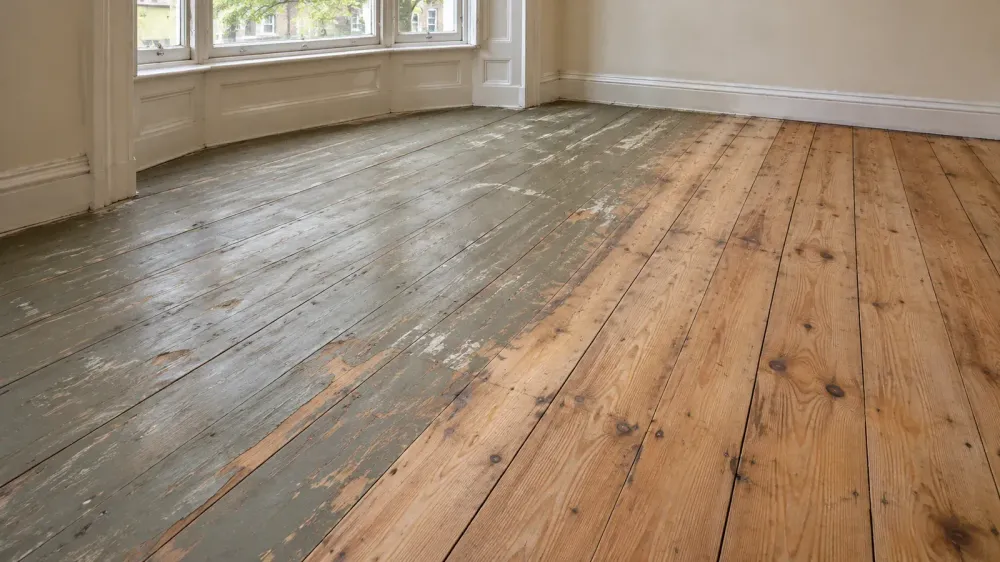
Yes, painted floorboards can often be sanded back to bare timber and refinished, but two questions come first: is the paint safe to disturb, and is the timber underneath worth exposing? In older British homes the paint may contain lead, which rules out dry sanding until it has been checked. And because paint is frequently used to hide patched boards, filler and mixed timber, the result is not always the uniform natural floor people expect.
Paint behaves differently from varnish or oil under an abrasive. It is usually thicker, softer when it heats up and quick to clog sanding paper, and it sits deep in joints, nail holes and the grain of softwood boards. A machine that removes a clear lacquer in a single pass can smear paint across the surface instead of lifting it.
There is also the question of what else is in the layers. Painted floors in period properties often carry several generations of coatings: an original stain or varnish border, later paint, perhaps a modern floor paint on top. Each behaves differently, and the oldest layers are the ones most likely to contain lead.
HSE guidance on lead notes that properties built before the 1980s may contain lead paint. It warns against dry sanding old paint and against using blowlamps or gas torches, and points instead to methods such as chemical paint stripper, wet abrasive paper and on-tool extraction.
For a homeowner, that translates into a few simple rules:
Lead test kits are widely available for a first indication; for certainty, a laboratory test of a paint sample is more reliable. If lead is present, a contractor should agree a method that does not create lead dust, which usually means stripping the bulk of the paint by chemical or wet methods before any light sanding of clean timber.
Even when the paint itself is safe, it is worth inspecting what you can before committing to a natural finish. Look at:
If the floor was originally laid to be covered, for example with a central carpet and a stained border, the centre boards may be poorer quality or show wear patterns that will remain visible.
The right approach depends on the paint, the number of layers and the condition of the boards. In broad terms:
| Method | When it may suit | Limitations |
|---|---|---|
| Chemical stripping, then light sanding | Thick or multi-layer paint, or where lead is suspected | Slower; product must suit the paint; residues must be neutralised and cleaned before sanding |
| Wet abrasion and scraping | Small areas, edges and detailed sections | Labour-intensive; the timber must dry before finishing |
| Mechanical sanding with extraction | Thin, modern, confirmed lead-free coatings on sound boards | Paint clogs abrasives; pigment can be driven into soft grain and joints |
| Leave painted and repaint | Poor or heavily patched timber, or where removal would be disproportionate | Needs proper preparation and a floor-grade paint |
On softwood boards such as pine, pigment often lodges in the open grain and between boards. Removing every trace may mean taking off more timber than is sensible, so it is reasonable to accept some colour in the joints of a period floor.
Once the paint is off and the boards are sanded, you will see the floor as it really is. That may include:
A stain can soften contrast between boards, but it will not make mismatched timber identical, and it needs to be tested on the actual floor. If the timber turns out to be too patched or too thin for a natural finish, repainting the floor with a hard-wearing floor paint, or replacing a limited number of boards, may be the better outcome.
If you have only just lifted carpet and found old boards, our guide to checks for exposed Victorian pine floorboards covers the wider inspection. If gaps between boards are a concern, see why floorboard gap filler cracks.
Not necessarily. Pigment can stay in joints, nail holes and open grain. Trying to remove all of it by sanding can thin the boards unnecessarily, so the aim is usually a clean, sound surface rather than total removal.
Do not dry-sand paint that may contain lead. Have it tested first, and if lead is present, use a removal method that avoids creating dust, following HSE guidance.
No. A restored painted floor usually shows its history: repairs, colour variation and character marks. Many people like that, but it is worth deciding in advance whether you would rather repaint some or all of it.
If you are weighing up whether to restore painted floorboards, contact us to discuss the floor. Tell us the age of the property, the condition of the paint and any lead-test results you already have. We can discuss how to share photographs and whether sanding or another approach is appropriate. Read about our floor sanding service.
Tell us about your floor and what you would like to achieve. We can discuss suitable options and your requirements.