When Should Floor Sanding Happen During a Renovation?
Sanding too early means the floor gets damaged by other trades; too late can delay moving in. How to fit floor sanding into the order of a renovation.
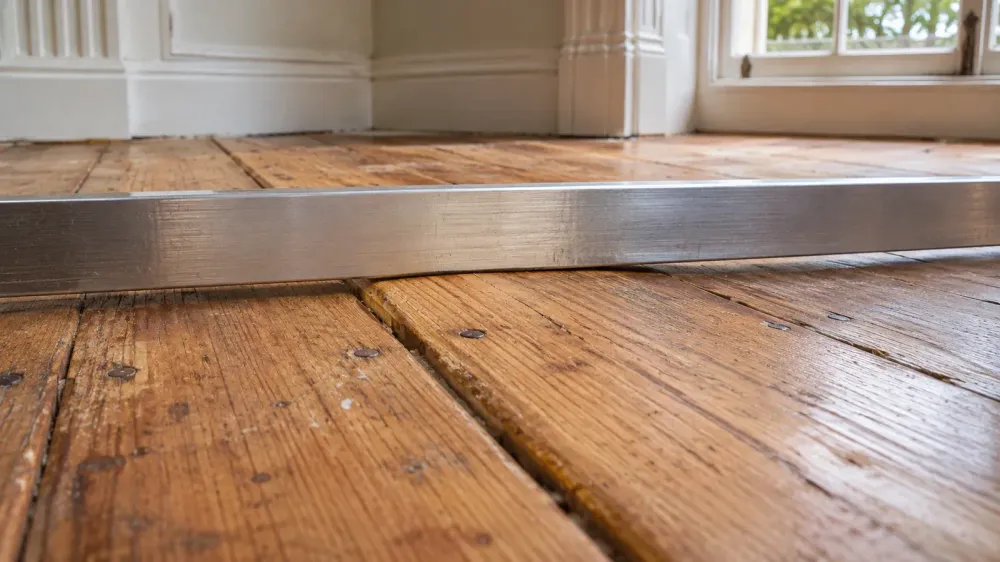
Whether uneven floorboards should be sanded or repaired first depends on what kind of unevenness it is. Raised board edges and slight lipping on a stable floor can often be improved by sanding. Boards that move, bounce, dip between joists or curl because of moisture need the cause dealing with first, because sanding removes timber but cannot stop movement. Sanding a moving or damp floor flat simply creates a new problem when it moves or dries again.
Adjacent boards sit at slightly different heights, so you feel a small ridge as you walk. This is common in old floors where boards were never exactly matched, or where some have been lifted and re-laid. On a stable floor, sanding is often the answer, because a sanding machine levels small differences between boards.
The edges of each board sit higher than its centre, so the floor looks rippled across its width. Cupping usually means the underside of the board has taken up more moisture than the top: a damp subfloor, a leak, poor ventilation below a suspended floor or high humidity. Sanding cupped boards flat while they are still damp is a mistake. When they dry, they can crown, with centres higher than edges, and the floor ends up uneven the other way and thinner.
The centre of each board is higher than the edges. It can follow a previous sanding of cupped boards, or the top surface becoming wetter than the underside. Again, the moisture condition has to stabilise before anything else is done.
A dip in a doorway, a hump along a line, or a floor that moves when you walk across it points to the structure beneath: loose boards, failing fixings, a joist that has sagged, been notched for pipes or cables, or lost support. These are repair and sometimes structural issues, not surface ones.
You can learn a lot without lifting anything:
Do not drive extra nails or screws into the floor at random; pipes and cables often run in the void immediately beneath the boards.
| Symptom | Likely cause | What usually comes first |
|---|---|---|
| Slight raised edges on a solid, dry floor | Natural variation, old re-laying | Sanding can often level these |
| Cupped boards | Moisture below the boards | Find and fix the moisture; allow time to dry; reassess |
| Crowned boards | Previous sanding of cupped boards, or moisture changes | Stabilise conditions; reassess before any sanding |
| Squeaky or springy boards | Loose fixings, gaps between boards and joists | Re-secure boards; see why floorboards squeak |
| Dips and humps along lines | Joist problems or loss of support | Structural assessment; joist repair by a suitable trade |
| Split or rotten boards | Age, damage, damp | Replace the affected boards before sanding |
Once the floor is stable and dry, sanding can deal with remaining minor differences. A machine can only take off a limited amount of timber before a board becomes too thin, and on tongue-and-groove boards the tongue limits how far you can go. Engineered floors have far less sandable timber, so they cannot be levelled by heavy sanding at all. If you are unsure whether there is enough timber left, our guide to whether a damaged floor can still be sanded explains what is checked.
Sanding can:
Sanding cannot:
If you see signs of a structural problem, such as a significant dip, a floor that slopes noticeably, cracked ceilings below, or joists that are rotten or heavily notched, ask a builder, joiner or structural engineer to look at it before planning floor sanding. A floor-sanding contractor can advise on board repairs, but should not be making structural judgements from photographs.
It can level small differences between stable boards. It cannot correct dips, humps or slopes in the structure, and it should not be used to flatten boards that are cupped because of moisture.
Until the moisture source is fixed and the boards have returned to a stable moisture content similar to unaffected parts of the floor. That can take weeks; moisture readings are more reliable than a fixed date.
It can help with loose boards, but it will not correct moisture or joist problems, and random fixings risk hitting pipes and cables.
If your floor is uneven, contact us about a floor assessment. Describe the movement or height differences and any leaks or building work; we can arrange how to share photographs. Our wood floor repair service covers suitable board repairs. Structural concerns require the appropriate specialist.
Tell us about your floor and what you would like to achieve. We can discuss suitable options and your requirements.