When Should Floor Sanding Happen During a Renovation?
Sanding too early means the floor gets damaged by other trades; too late can delay moving in. How to fit floor sanding into the order of a renovation.
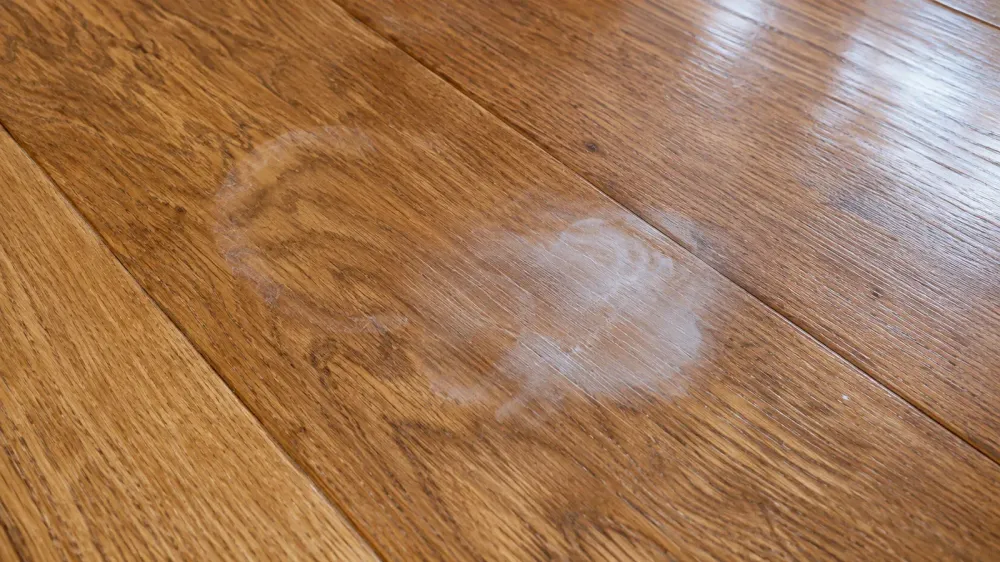
White marks on a wooden floor are usually a problem in or on the finish, not in the wood itself. The most common causes are moisture trapped in the coating, heat, residue from cleaning products and a finish worn thin. That is good news, because finish problems can often be corrected without sanding the whole floor. The important thing is to identify which one you have before trying a remedy, because some popular home fixes make the damage worse.
It helps to separate white marks from dark ones. A white or milky mark generally sits in the finish layer: moisture or heat has disturbed the coating, or something has been left on top of it. A black or grey mark usually means water has reached the timber itself, often reacting with natural tannins or allowing mould growth. Dark marks need a different assessment, which we cover in our guide to black stains on wooden floors.
A plant pot, a wet glass, a damp mat or a spill left overnight can leave a pale ring or patch. Moisture has entered the surface of the finish and become trapped, making it look cloudy. These marks are often round or follow the shape of whatever stood on the floor.
A hot dish, a hair straightener or a radiator pipe can leave a white or hazy mark in some finishes. Heat marks are often sharp-edged and appear quickly.
Too much cleaner, the wrong product for the finish, a polish or a "shine restorer" can leave a dull, streaky or cloudy film. This tends to appear across larger areas, follows the direction of mopping and may feel slightly tacky or greasy.
Along walkways, in front of a sofa or by a door, the finish can wear thin and look pale or grey compared with the rest of the floor. On an oiled floor this often looks dry and whitish; on a lacquered floor it can appear as a matt, scuffed band.
Occasionally a newly applied coating turns cloudy because of conditions during application, such as low temperatures, high humidity or a coat applied too thickly. If marks appear soon after refinishing, raise it with whoever did the work rather than treating the floor yourself.
Look at the mark in daylight, from low down and from different angles, and ask:
Home remedies for white marks on furniture are widely shared, and some of them are unsuitable for floors. Avoid:
| Likely cause | First step | If it does not improve |
|---|---|---|
| Recent moisture mark | Remove the source, keep the area dry and ventilated, and give it time | Local repair of the finish, or recoat of the affected board or room |
| Heat mark | Leave it undisturbed and ask for advice on the finish | Local refinishing; on lacquer, the board or area may need abrading and recoating |
| Cleaning residue | Deep clean with the finish manufacturer's recommended cleaner | A professional clean and, if needed, a maintenance coat |
| Worn oiled finish | Clean, then apply a compatible maintenance oil | Sanding and re-oiling if bare timber has become dirty or grey |
| Worn lacquer | Clean and assess the remaining coating | Light abrasion and recoat, or sanding if the lacquer is worn through |
| Cloudy new finish | Contact the installer | Investigation of application conditions and the product used |
On an oiled or hardwax-oiled floor, local repairs often blend well: the affected area can be cleaned, lightly abraded where the manufacturer advises, and re-oiled. On a lacquered floor, a patch repair is more likely to show, and the usual remedy for a persistent mark is to abrade and recoat a whole board, a defined area or the room. Our guide to recoating a wood floor without sanding explains when that works.
Sanding back to bare timber is only needed if the mark has gone through the finish into the wood, or if the finish is failing generally.
No. Heat, cleaning residue and worn finish can all look similar. The shape of the mark and what happened in that spot are the best clues.
Yes, if the mark is in the finish, because sanding removes the finish. But it is often unnecessary: many white marks can be dealt with by cleaning or a local repair of the coating.
Mild moisture marks sometimes fade as the moisture escapes. Heat marks and residue usually do not.
If a white mark persists after the source has been removed, contact us to discuss an assessment. Describe the mark, its history and the finish if known; we can arrange how to share photographs. Our wood floor repair and floor care and maintenance services cover different approaches depending on the cause.
Tell us about your floor and what you would like to achieve. We can discuss suitable options and your requirements.